Iran-Saudi Conflict, do we have a dog in this fight?

the AZEL

PERSPECTIVE

Commentary on Cuba's Future, U.S. Foreign Policy & Individual Freedoms - Issue 43A
 
This Azel Perspective was first published in 2016.
Iran-Saudi Conflict, do we have a dog in this fight?
Share
Tweet
Forward
Following the execution by Saudi Arabia of a prominent Shiite cleric, and the subsequent demonstrations and burning of the Saudi embassy in Iran, tensions between the two countries have escalated.  The region is now facing a multinational sectarian-cultural conflict.   For most of us, only tangentially familiar with Middle Eastern politics, the root causes of the conflict are nearly impenetrable.
The U.S. administration also appears clueless. WikiLeaks documents quoted then Secretary of State Hillary Clinton reporting that “Donors in Saudi Arabia constitute the most significant source of funding to Sunni terrorist groups worldwide.” Her successor, Secretary of State John Kerry, explained U.S. accelerated arms delivery to Saudi Arabia in the Yemen conflict by stating that “we’re not going to step away from our alliances and our friendships.” Huh?

The Iran-Saudi crisis presents the United States with significant foreign policy challenges. In colloquial terms the most basic question is: Do we have a dog in this fight?

To begin with, the current crisis is only the latest episode of a rivalry that dates from the 7th century. Today the rivalry has sectarian, ethnical, governance, and geopolitical components.

The sectarian element for the tensions is along Sunni-Shia lines. Saudi Arabia is a conservative “Wahhabi” Islamic Kingdom, 90% Sunni, with a tradition of close ties with the West. Iran is a Twelver, 90% Shia, republic founded by the anti-Western 1979 Iranian Revolution.

The original split between Sunnis and Shiites occurred in 632 A. D. soon after the death of the Prophet Muhammad. It concerned the rightful successor to the Prophet. The two sentence oversimplification of the dispute is that most of Muhammad's followers wanted the community to determine who would succeed him. A smaller group thought that leadership should stay within the family.

After the 1979 Iranian Revolution, Iran began to attack and undermine the religious legitimacy of the Saudi Kingdom. For its part, Wahhabi Saudi Arabia has been outspoken against the “heretic” Shiite dogma.

The cultural basis for the animosity follows Arab-Persian rivalries. It appears Persians will never forget their loss to the Arabs in the Battle of Qadisiyya 1,400 years ago. This engagement shaped the national psyche of both cultures and may underlie Persian racism against Arabs.  The battle is believed to have been a decisive engagement between the Arab  and Persianarmies that resulted in the Islamic conquest of Persia.

The governance disputes stand on the Iranian principle of “Guardianship of the Islamic Jurists”, which extends a supra-national jurisdiction to a Supreme Islamic Jurist over all Muslims regardless of nationality.  The Saudi monarchy, in contrast, relies on tribal religious leaders that pledge allegiance to the monarchy provided it follows Islamic sharia law.

Add to all this competing hegemonic aspirations for leadership of the Islamic world, and we can begin to decipher the present day Iran-Saudi geopolitical brawl.

Both regimes exert near-totalitarian repressive control, and abuse human rights with abandon.  Saudi Arabia has been a putative ally of the United States for decades, and U.S. officials inexplicably often exhibit obsequiousness towards the oppressive Kingdom. Iran spews anti-American rhetoric at every opportunity.

Yet, the Obama administration recently concluded a very controversial, and arguably unwise, nuclear treaty with Iran which, from the Saudi point of view, means a monumental loss of influence for Saudi Arabia.  The deal enriches Iran and enhances its ability to continue its aggressive foreign policy for hegemony in the region and in the Islamic world.

In an apparent foreign policy balancing act, it has been reported that: “Administration officials are promising a major strengthening of the U.S. commitment to Saudi Arabia… possibly including a nuclear commitment to their security.”

This foreign policy haziness does not bode well for U.S. national interests.  Given the history of U.S. foreign policy failures in this complex region, a better approach may be, what I call, the doctrine of “Strategic engagement and tactical neglect.” By this I mean a policy that unabashedly gives voice to individual freedoms and democratic values, but refrains from overt meddling. 

Unfortunately, the administration seems to have chosen the opposite approach. When dealing with despotic regimes such as Saudi Arabia, Iran, and Cuba, the administration embraces the despots and refrains from being the voice of freedom.

Please let us know if you Like Issue 43A - Iran-Saudi Conflict, do we have a dog in this fight? on Facebook this article.
This article was originally published in English in the Miami Herald and in Spanish in El Nuevo Herald.
 
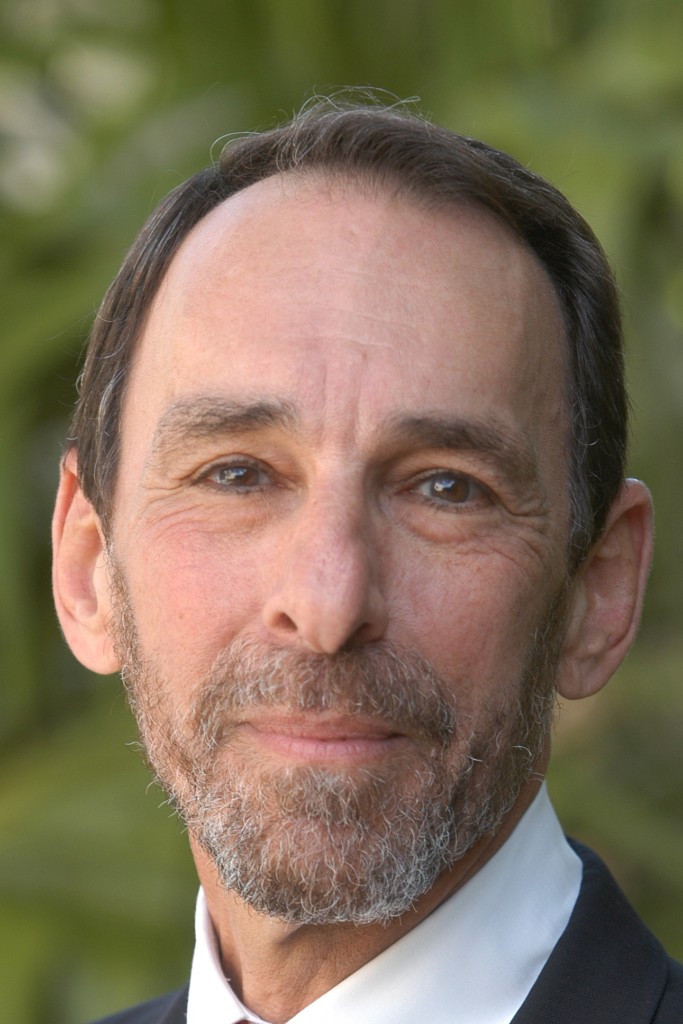
José Azel, Ph.D.
José Azel left Cuba in 1961 as a 13 year-old political exile in what has been dubbed Operation Pedro Pan - the largest unaccompanied child refugee movement in the history of the Western Hemisphere.  

He is currently dedicated to the in-depth analyses of Cuba's economic, social and political state, with a keen interest in post-Castro-Cuba strategies as a Senior Scholar at the Institute for Cuban and Cuban-American Studies (ICCAS) at the University of Miami and has published extensively on Cuba related topics.

In 2012 and 2015, Dr. Azel testified in the U.S. Congress on U.S.-Cuba Policy, and U.S. National Security.  He is a frequent speaker and commentator on these and related topics on local, national and international media.  He holds undergraduate and masters degrees in business administration and a Ph.D. in International Affairs from the University of Miami. 

Dr. Azel is author of Mañana in Cuba: The Legacy of Castroism and Transitional Challenges for Cuba, published in March 2010 and of Pedazos y Vacios, a collection of poems he wrote as a young exile in the 1960's.

José along with his wife Lily are avid skiers and adventure travelers.  In recent years they have climbed Grand Teton in Wyoming, trekked Mt. Kilimanjaro in Tanzania and Machu Pichu in Peru.  They have also hiked in Tibet and in the Himalayas to Mt. Everest Base Camp.

They cycled St. James Way (
El Camino de Santiago de Compostela) and cycled alongside the Danube from Germany to Hungary. They have scuba dived in the Bay Islands off the Honduran coast. 

Their adventurers are normally dedicated to raise funds for causes that are dear to them. 
Watch Joe & Lily summit Kilimanjaro.

Books by Dr. José Azel
Mañana in Cuba is a comprehensive analysis of contemporary Cuba with an incisive perspective of the Cuban frame of mind and its relevancy for Cuba's future.
Buy now

 
Pedazos y Vacíos is a collection of poems written in by Dr. Azel in his youth. Poems are in Spanish.
Buy now
To friend, follow or email author click on the icons below:
Copyright © 2015 Azel & Associates, All rights reserved.
If you are receiving this email it is because we met you at some point on an adventure.

Our mailing address is:
Azel & Associates
440 Sawgrass Parkway, Suite 106
Sunrise, FL 33325

Cuba Decides

"The dictatorship of Havana engages in state terrorism against its citizens," states Luis Almagro, Secretary General of the OAS.
 
 
This morning at a press conference, we requested international support and denounced the situation of the 53 promoters of Cuba Decide, the vast majority of which are members of the Patriotic Union of Cuba who remain on hunger strike on the Island, demanding an end to the repression that prevents the humanitarian efforts of UNPACU activists.
 
 
The participants warned about the serious danger the strikers face, as they continue to be harassed and surrounded by the police. They also requested action from the international community to stop the regime's impunity and constant repression. With his denunciation of "State terrorism that the dictatorship of Havana applies against its citizens", Luis Almagro, joins in the accusations that several promoters of Cuba Decide made before the IACHR in response to the repressive patterns implemented by the regime on the Island.
 
At the press conference, organized by the promoters of Cuba Decide, José Daniel Ferrer, Leader of UNPACU and promoter of Cuba Decide on hunger strike, Katherine Mojena, member of UNPACU and promoter of Cuba Decide on hunger strike, Luis Manuel Otero Alcántara, General Coordinator of the MSI and Rosa María Payá, director of the Foundation for Pan-American Democracy and promoter of Cuba Decide.
 
José Daniel Ferrer, who has been on a hunger strike for seven days, explained the reasons for taking these extreme measures. "The Castro-communist regime leaves us no other option," he said. In addition, Ferrer asked the United States to put “respect for human rights before business in its review of policy towards Cuba” and assured that the regime “makes fun” of the European Union, because “with its collaborative projects they help to consolidate the repressive and controlling policies of the Castro-communist regime.”
 
Another striker, Katherine Mojena, warned that she and her fellow strikers are in danger of being forcibly evicted from the UNPACU headquarters – a habitual pattern of repression to eliminate dissenting voices. The regime took similar actions in 2019 against other UNPACU strikers, and in November 2020 against the San Isidro Movement.
 
Luis Manuel Otero Alcántara was present via a video wherein he reinforced Mojena's anticipated warning and expressed total solidarity with the strikers.
 
Finally, Rosa Maria Payá stated that “Raul Castro and Miguel Diaz Canel, virtually in command of the Cuban State, are responsible for state terrorism that is inflicted upon citizens in Cuba and today they are also responsible for the physical integrity of each of the strikers. We ask the governments and democratic institutions of the Americas and Europe to act. This is not the time for unilateral concessions, it is time to pressure the dictatorship in favor of the Cuban people's demand for democratic change."
 
We will continue to report on the evolution of the hunger strike and its participants through the social media profiles of Cuba Decide.
 
 
# # #

About CUBA DECIDE
Cuba Decides is a citizen initiative to change the current political and economic system towards democracy and the rule of law.

THE STRATEGY
Generate the necessary pressure to olbige the government to submit to the will of the people through non-violent actions of citizens and the international community.

THE TOOL
Cubans must decide their future and be free.
Cuba Decide proposes that the will of the Cubans be expressed and complied with through a binding plebiscite - a direct vote of the people - in Cuba to make the change in the system concrete.

JOIN US!
A mass mobilization effort is underway!
Learn more and support cubadecide.org

Be part of our conversations on Facebook.com/CubaDecide and on Twitter and Instagram following @CubaDecide and using the hashtag #CubaDecide.

Make sure Cuba Decide e-mails are delivered: Add info@cubadecide.org to your address book, whitelist or safe-sender list.

About FDP
The Fundación para la Democracia Panamericana (FDP) established in 2015, has the mission of defending and promoting democracy in the Americas. FDP has no religious or political affiliation and collaborates with local and international organizations that are committed to democracy and respect for human rights.

Donations to FDP are tax-deductible in the United States as a public non-profit organization registered under Section 501 (c) (3) of the Department of the Treasury (IRS).

www.FundacionDemocraciaPanamericana.org
786-717-6334 / P.O. Box 441716 Miami FL 33144-1716 US

Free Cuba Now

To promote a peaceful transition to a Cuba that respects human rights
and political and economic freedoms


 

SFRC recognizes Cuban opposition movements. The case for nonviolent struggle and sanctions. Corruption exposed at the UN Human Rights Council

Ladies in White and the San Isidro Movement recognized by the U.S. Senate Foreign Relations Committee

Dictatorships and bad actors on the international stage are working to strip civil society and democracies of the tools to nonviolently defeat them. They fear and despise the legacy of Gene Sharp (1928 – 2018) founder of the Albert Einstein Institution, and a theoretician of nonviolent action who in 1990 at the National Conference on Nonviolent Sanctions and Defense in Boston, made the case for nonviolent struggle:

"I say nonviolent struggle is armed struggle. And we have to take back that term from those advocates of violence who seek to justify with pretty words that kind of combat. Only with this type of struggle one fights with psychological weapons, social weapons, economic weapons and political weapons. And that this is ultimately more powerful against oppression, injustice and tyranny than violence."

According to Professor Sharp in his 2013 book HOW NONVIOLENT STRUGGLE WORKS (available online) , third parties on the international scene, including countries, can play a supplementary and complementary role but are never leading the struggle.

"Third-party actions may include protests, public declarations, demonstrations, diplomatic actions, economic sanctions, and the like. They ought to be seen as supplementary and complementary, but never as the main actions of the struggle. The proportion of successes among past cases of international nonviolent action, especially by third parties, is extremely small. The actions have been generally symbolic, and more substantial types, as economic sanctions, have not been applied on the systematic and sustained basis required for effectiveness. International action is not a substitute for internal action by the grievance group itself."

Nonviolent movements can obtain a measure of protection with international solidarity, provided through reporting on their plight, and a range of tools that include economic and political sanctions by both civil society and other nation states. Human rights abusers, and outlaw regimes that murder their own people view these instruments with concern, and have managed through coordination with each other to reshape international institutions to undermine human rights. Worse yet, companies wishing to make short term profits with these regimes are also hostile to sanctions against them.

There is also a moral dimension to not cooperating with bad actors, especially those engaged in crimes against humanity, or genocide against their own or other populations. Engaging in commerce with outlaw regimes carrying out criminal activities either at the level of a state or a company can lead to complicity in their crimes. FordGM, and IBM, along with others had much to answer for after their collaboration with Nazi Germany prior to and during WW2 became known. Yahoo! has a lot to answer for in providing information to the Peoples Republic of China to hunt, jailtorture, and kill Chinese dissidents for internet related offenses, and to a lesser extent so do Google and Microsoft with violating freedom of expression in China.
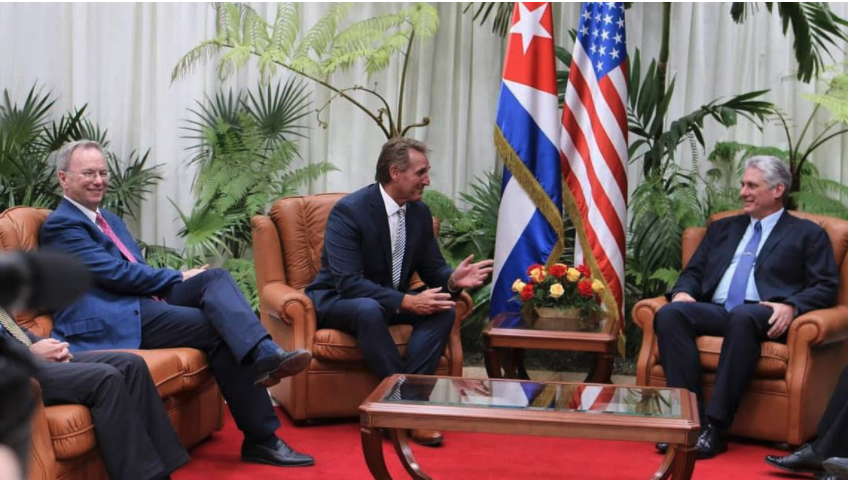
Díaz-Canel, right, Sen. Jeff Flake, center, and Eric Schmidt, former exec chair Google 2018 (B Perlmutter Twitter)

Google over the past few years has engaged with the Cuban dictatorship in an effort to expand their presence on the island, but "a source" claimed in a September 1, 2017 article in The Miami Herald that Google had included a "freedom of information clause" to store content on Google servers in Cuba.  Considering Google's negative track record in the People's Republic of China the obvious question is "what could go wrong?" and the answer when dealing with totalitarian regimes is "a lot" including the theft of technology, intellectual property, and the endangering of dissidents lives. Amnesty International called out the company in 2018 for trying to set up a censored search engine in China called "Project Dragonfly."

Mariela Machado Fantacchiotti, telecommunications engineer and program manager of operations at Engineering for Change writing in the Inter-American Dialogue's publication Latin America Advisor on April 16, 2019 put it succinctly: "This deal with Google is a huge success for the company in entering a new market, but I am cautious to see how it might benefit the Cuban people and under which conditions, surveillance-wise.”