No Help For Daughter Crying Unconsolably For Her Ailing Mother, In Communist Cuba

https://rumble.com/v1eamxf-no-help-for-daughter-crying-unconsolably-for-her-ailing-mother-in-communist.html

Cuba's Salary Of Around $20 A Month, A Roll Of Toilet Paper Cost $5

https://rumble.com/v1e75o9-cubas-salary-of-around-20-a-month-a-roll-of-toilet-paper-cost-5.html

From Cuba: Child With Respiratory Deficiency Needs Help Urgently

https://rumble.com/v1e1doh-from-cuba-child-with-respiratory-deficiency-needs-help-urgently.html

CSI

7/28/2022
 
A publication of the Cuban Studies Institute
“Bits of Cuban History” is a new series of weekly publications highlighting historical events and information from Cuba’s colonial and national periods.
 
We hope you enjoy this new publication.
 
Following is the 29th in this new series.
 
 
BITS OF CUBAN HISTORY

BRIGADE 2506
 
The nucleus of a Cuban exile force of 1,400 men, they Bay of Pigs invasion force, trained by the United States Central Intelligence Agency in Guatemala, which sailed from Puerto Cabezas, Nicaragua, on April 14, 1961, to overthrow the government of Fidel Castro, begun three days later. The brigade was originally composed of six battalions of two hundred men each. The designation “2506” was adopted from the serial number of one of its members killed during training. The political views of the brigade ranged from center to far right. There was virtually no one from the left, but socially, all classes were represented. Training had been brief - from two weeks to two months. The brigade landed at beaches along the Bay of Pigs. The heavy fighting was especially in the Palpite Rotonda, San Blas, Girón and Playa Larga. The brigade had tanks, but no heavy artillery, and inadequate air cover. Some 1,189 survivors were captured by the Cuban military and held for public trial. After eighteen months’ imprisonment, the brigade leaders were ransomed for several million dollars and their men exchanged for medical supplies and agricultural equipment.

 
Read on Web
This is a publication of the Cuban Studies Institute. 

Our mailing address is:
1500 South Dixie Highway, Bank of America Bldg., 2nd Floor
Coral Gables, FL  33146
Tel: 786-803-8007
Fax: 786-803-8068
Email: cubanstudies@cubanstudiesinstitute.com

Want to change how you receive these emails?
You can update your preferences or unsubscribe from this list.

Cuba Surrounded By Water, But No Fish To Eat

https://rumble.com/v1dyqv7-cuba-surrounded-by-water-but-no-fish-to-eat.html

400 Cuban Activist Announce They Are On Strike

https://rumble.com/v1dtkcp-400-cuban-activist-announce-they-are-on-strike.html

Just Like IN Cuba, Al Gore Wants Democracy Banned

https://rumble.com/v1dq9fx-just-like-in-cuba-al-gore-wants-democracy-banned.html

CSI

A publication of the Cuban Studies Institute
 

July 26, 2022

 
Dear friend:

The Cuban Studies Institute has received a donation from Ralp Galliano of several copies of the important book, “The Fourh Floor” written by Earl E.T. Smith, former U.S Ambassador to Cuba.  The books is now out of print and discusses the Castro Communist Revolution and its impact on Cuba and on U.S. policy toward Cuba.

First published in 1962, The Fourth Floor describes in painful detail just how and why the communists were able to gain control of the strategically located island only ninety miles from the United States mainland.  Smith’s explanation of events remains timely today as it clearly demonstrates the disastrous effects of an ill-advised and ineffective foreign policy development structure.  As Smith’s title suggests, a great deal of responsibility for the Cuban fiasco must be borne by the bureaucrats who occupied the “fourth floor” of the State Department building in Washington, D.C.  As President Eisenhower’s “man in Havana” from July 1957 to January 1959, Ambassador Smith witnessed firsthand the events that resulted in the fall of Fulgencio Batista and the advent of Castro.

CSI is making this book available to our friends and followers for $35 per copy (free shipping).  The Fourth Floor is being sold at Amazon for more than twice this amount.

This is a valuable story of Castro rise to power and of the failures of American foreign policy in the 1950s.  Please order before this limited number of books are sold out.  Thank you.

Saludos


Jaime Suchlicki
Director


Order from: 

Cuban Studies Institute Name:_________________________________

Address:________________________________________________

City/State/Zip:____________________________________________

Phone:_________________________________________________

Email:__________________________________________________

Quantity: _______


Method of Payment

 [ ] Check enclosed (payable to Cuban Studies Institute

 [ ] Please place a one-time charge on the credit card listed for the amount of $______________

 [  ] MasterCard  [  ] Visa [  ] American Express [  ] Discover

 
Card Number:__________________________

CVV Number___________ Exp. _______

Name as it appears on card: ______________________________________________

Signature: ______________________________________

Date: ____________

 
By Phone: 786-803-8007
By Fax: 786-803-8068
By Mail:  Cuban Studies Institute, 1500 S. Dixie Highway, Suite 200, Bank of America Building, Coral Gables, FL 33146
 
THANK YOU!                                           
 

This is a publication of the Cuban Studies Institute. 

Our mailing address is:
1500 South Dixie Highway, Bank of America Bldg., 2nd Floor
Coral Gables, FL  33146
Tel: 786-803-8007
Fax: 786-803-8068
Email: cubanstudies@cubanstudiesinstitute.com

Want to change how you receive these emails?
You can update your preferences or unsubscribe from this list.

CSI

7/26/2022
 
A publication of the Cuban Studies Institute
“Bits of Cuban History” is a new series of weekly publications highlighting historical events and information from Cuba’s colonial and national periods.
 
We hope you enjoy this new publication.
 
Following is the 28th in this new series.
 
 
BITS OF CUBAN HISTORY
 
 Movimiento Veintiseis de Julio (26th July Movement)
 
 
Name given to Fidel Castro’s revolutionary cause, adopted from the date of his ill-fated 1953 attack on the Moncada barracks in Santiago de Cuba.  He began the movement in prison, and after his 1955 release he traveled in the United States and Mexico seeking funds for it.
 
His forces sailed from Mexico to Oriente province in 1956 aboard the yacht Granma again hoping to defeat Batista’s forces and touch off an island-wide insurrection.  The landing was intercepted and the accompanying uprising in Santiago was crushed, most of the leaders killed or imprisoned, and Castro and his surviving followers fled into the Sierra Maestra, where for three years the movement grew in prestige, strength and importance as it successfully waged a guerrilla war against Batista’s forces.  The general strike that the movement’s urban underground organized on April 9, 1958, fizzled out, but did serve to illustrate the movement’s organizational strength.  Its underground cells conducted bombings, sabotage, and kidnappings throughout 1958, as well as distributing propaganda that undermined the foundations of government, helping create the somber atmosphere of a civil war.  Following the success of the Revolution of 1959 the movement became an integral part of the new governing body of Cuba, merging in 1961 with the Partido Socialista Popular and the Directorio Revolucionario into the Organizaciones Revolucionarias Integradas (which became Castro’s ruling organ and the forerunner of a new Partido Comunista de Cuba).
 
Read on Web
This is a publication of the Cuban Studies Institute. 

Our mailing address is:
1500 South Dixie Highway, Bank of America Bldg., 2nd Floor
Coral Gables, FL  33146
Tel: 786-803-8007
Fax: 786-803-8068
Email: cubanstudies@cubanstudiesinstitute.com

Want to change how you receive these emails?
You can update your preferences or unsubscribe from this list.
 

Does Everyone Want Democracy?


the AZEL

PERSPECTIVE

Commentary on Cuba's Future, U.S. Foreign Policy & Individual Freedoms - Issue 263
 
José Azel's latest books "On Freedom" and "Sobre La Libertad" are now available on Amazon. 

Does Everyone Want Democracy?

ShareShare
TweetTweet
ForwardForward
Does everyone want democracy? This is a thought-provoking question, and the title of a book by political anthropologist Paula L. W. Sabloff, where professor Sabloff offers her insights on the transition from Soviet-style communism to democracy in Mongolia.  Her work advances some well documented answers to one of the most policy relevant questions of our times: Is democracy a universal good desired by all cultures? 
As a bonus for this reader, the book introduced me to Mongolia, a country that has escaped my research and travel interests. In this column, I will borrow Dr. Sabloff’s analysis of the changing ideas of democracy and capitalism as Mongolians forsake socialism and seek to implement democracy and capitalism. I believe her conclusions may be applicable to Cuba if it undergoes a similar transition sometime in the future.

Her years of anthropological research in Mongolia led Sabloff to conclude that “…once democracy is institutionalized, people no longer consider it a goal or an end in itself.  Instead, they see [democracy] as a means to an end.  They believe that democracy will better enable them to align their deeply held values and personal goals with the lifestyle they desire than other forms of government, particularly communism.”

In other words, people define democracy in terms of “what they think democracy will do for them.” Sabloff argues that although many people around the world want democracy, not everyone wants the same kind of democracy.

For example, when asked: What is democracy about?, the subjects she interviewed would instead provide an answer to the question: What is democracy for? That is, the interviewees concern and answers focused on how democratic governance would affect their way of life. I suspect this would be the same genre of responses we would get if we were to ask these questions in a Cuba in transition.

Dr. Sabloff analyses Mongolian democracy in terms of five subdomains: human rights, political freedom, economic freedom, responsibilities of the government and duties of citizens. Thus, it is necessary here to make a distinction between freedom and democracy.

We often use these terms interchangeably equating liberty with democracy. Sabloff’s interviewees surely did. Our modern conception of liberty, a product of the Enlightenment, asserts that as individuals we have rights that are universal. These rights do not depend on membership in a community or in government. We are born free, and we institute governments to protect our freedoms.

The United States was born as a republic, not a democracy and our constitution was designed to advance liberty not democracy. The Framers sought to protect individual rights from encroachment by government and by fellow citizens. The Constitution’s intent was to govern the government, not the people.

I suspect most of us are surprised to learn that the word “democracy” was deliberately avoided by the Framers and does not appear in the Declaration of Independence or in the Constitution. The Founding Fathers were deeply concerned with the problems inherent in a tyranny of the majority and went to great lengths to design a federal government not based on the will of the majority.

It takes time for a democratic culture to develop following non-democratic governments as would be the case in Cuba.  An important reminder is that even if nations are moving from socialism to capitalism, they are not necessarily changing from totalitarian rule to democratic rule. And, as Sabloff points out, Mongolians needed help to “transition from seeing themselves as serving the government (as they did under socialism) to seeing government as serving the people (as people do in a democracy).”

One troubling observation of the study is that Mongolians were more focused on the rights of citizenship than on the activities necessary to sustain democratic governance. Sabloff  suggests that Mongolians care about their freedoms, but are not particularly interested in active citizenship. Mongolians showed an indifference towards fulfilling the duties of citizenship.

Sadly, I fear this is what some future analyst will observe in Cuba; a politically disinterested population that “just wants to be left alone to figure out how to survive in a capitalist economy.”

Please let us know if you Like Issue 263 - Does Everyone Want Democracy? on Facebook this article.
We welcome your feedback.
Abrazos,
 
Lily & José
 
(click on the name to email Lily or Jose)
José Azel, Ph.D.
José Azel left Cuba in 1961 as a 13 year-old political exile in what has been dubbed Operation Pedro Pan - the largest unaccompanied child refugee movement in the history of the Western Hemisphere.  

He is currently dedicated to the in-depth analyses of Cuba's economic, social and political state, with a keen interest in post-Castro-Cuba strategies. Dr. Azel was a Senior Scholar at the Institute for Cuban and Cuban-American Studies (ICCAS) at the University of Miami, Jose Azel has published extensively on Cuba related topics.

In 2012 and 2015, Dr. Azel testified in the U.S. Congress on U.S.-Cuba Policy, and U.S. National Security.  He is a frequent speaker and commentator on these and related topics on local, national and international media.  He holds undergraduate and masters degrees in business administration and a Ph.D. in International Affairs from the University of Miami.

José along with his wife Lily are avid skiers and adventure travelers.  In recent years they have climbed Grand Teton in Wyoming, trekked Mt. Kilimanjaro in Tanzania and Machu Pichu in Peru.  They have also hiked in Tibet and in the Himalayas to Mt. Everest Base Camp.

They cycled St. James Way (
El Camino de Santiago de Compostela) and cycled alongside the Danube from Germany to Hungary and throughout southern France.  They have scuba dived in the Bay Islands off the Honduran coast and in the Galapagos Islands.

Their adventurers are normally dedicated to raise funds for causes that are dear to them. 
Watch Joe & Lily summit Kilimanjaro.

Books by Dr. José Azel
José Azel’s writings are touched with the wisdom of a master, and the charm of an excellent communicator. Anyone who wishes to understand why countries do, or do not, progress will find in this book the best explanations. And, from these readings emerge numerous inferences: How and why do the good intentions of leftist collectivism lead countries to hell? Why is liberty not a sub product of prosperity, but rather one of its causes?

If it was in my power, this work would be required reading for all college and university students, and I would also recommend its reading to all politicians, journalists, and policymakers. With his writings Azel accomplishes what was achieved in France by Frédéric Bastiat, and in the United States by Henry Hazlitt: Azel brings together common sense with intelligent observation, and academic substance. Stupendous,

Carlos Alberto Montaner
                                                                   BUY NOW
Los escritos de José Azel están tocados por la sabiduría de un maestro y la amenidad de un excelente comunicador. Cualquiera que desee entender por qué los países progresan, o no, encontrará en este libro las mejores explicaciones. De estas lecturas surgen numerosas inferencias: ¿Cómo y por qué las buenas intenciones del colectivismo de izquierda llevan a los países al infierno? ¿Por qué la libertad no es un subproducto de la prosperidad, sino una de sus causas?

Si estuviera en mis manos, esta obra sería de obligada lectura de todos los estudiantes universitarios, pero además, le recomendaría su lectura a todos los políticos, periodistas y policy makers. Con sus escritos Azel logra lo que Frédéric Bastiat consiguiera en Francia y Henry Hazlitt en Estados Unidos: aunar el sentido común, la observación inteligente y la enjundia académica. Estupendo.

Carlos Alberto Montaner
                                                           Compre Aqui
"Liberty for beginners is much more than what the title promises. It is eighty themes touched with the wisdom of a master, and the charm of an excellent communicator. Anyone that wishes to understand why countries do, or do not progress, will find in this book the best explanations. Stupendous"

Carlos Alberto Montaner

"Libertad para novatos es mucho más de lo que promete el título. Son ochenta temas tocados con la sabiduría de un maestro y la amenidad de un excelente comunicador. Cualquier adulto que desee saber por qué progresan o se estancan los pueblos aquí encontrará las mejores explicaciones. Estupendo."

Carlos Alberto Montaner

Compre Aqui

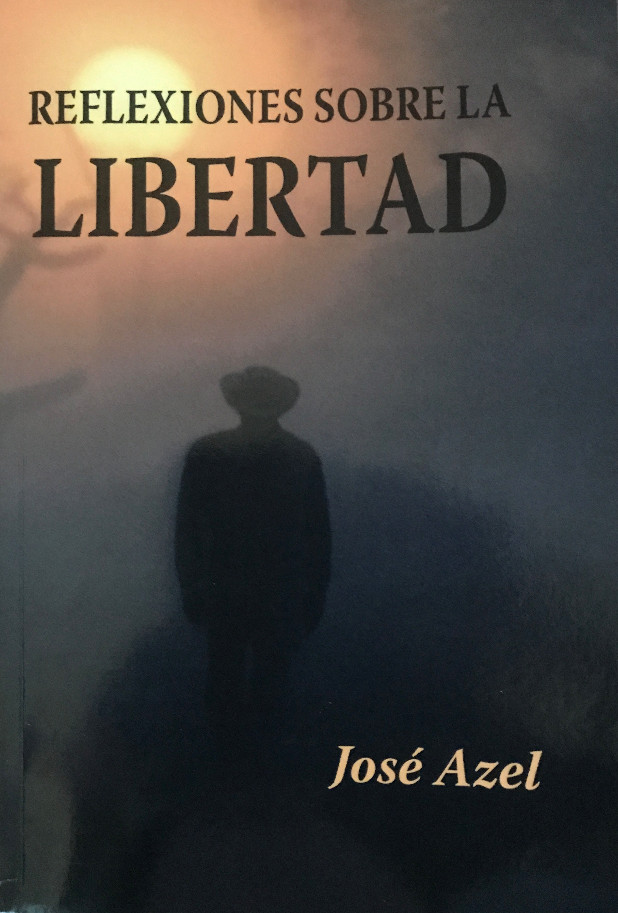
In Reflections on FreedomJosé Azel brings together a collection of his columns published in prestigious newspapers.  Each article reveals his heartfelt and personal awareness of the importance of freedom in our lives.  They are his reflections after nearly sixty years of living and learning as a Cuban outside Cuba. In what has become his stylistic trademark, Professor Azel brilliantly introduces complex topics in brief journalistic articles.
En Reflexiones sobre la libertad José Azel reúne una colección de sus columnas publicadas en prestigiosos periódicos. Cada artículo revela su percepción sincera y personal de la importancia de la libertad en nuestras vidas. Son sus reflexiones después de casi sesenta años viviendo y aprendiendo como cubano fuera de Cuba.  En lo que ha resultado ser característica distintiva de sus artículos, el Profesor Azel introduce con brillantez complejos temas en  breves artículos de carácter periodístico.
Mañana in Cuba is a comprehensive analysis of contemporary Cuba with an incisive perspective of the Cuban frame of mind and its relevancy for Cuba's future.
Pedazos y Vacíos is a collection of poems written in by Dr. Azel in his youth. Poems are in Spanish.
To friend, follow or email author click on the icons below:
Facebook
Twitter
Email
Click here to:
View this email in your browser

Access past issues
Access automated translations
Facilitate sharing
Print from your browser
Copyright © 2022 Azel & Associates, All rights reserved.
If you are receiving this email it is because we met you at some point on an adventure.

Our mailing address is:
Azel & Associates
440 Sawgrass Parkway, Suite 106
Sunrise, FL 33325

Want to change how you receive these emails?
You can update your preferences or unsubscribe from this list