Searching In Dumpster For Aluminum Cans He Can Sell In Order To Feed Himself

https://rumble.com/v236l30-searching-in-dumpster-for-aluminum-cans-he-can-sell-in-order-to-feed-himsel.html

Free Cuba Now!


To promote a peaceful transition to a Cuba that respects human rights
and political and economic freedoms


December 30, 2022

Time is running out to make your year-end donation. One of our donors has generously agreed to match donations up to $10,000 through December 31, 2022.

Join us in advancing this noble cause. By donating to the Center for a Free Cuba, you will make it possible for us to fulfill more effectively our objectives toward a free Cuba where human rights are once again respected.

2022 marks the twenty-fifth anniversary of the establishment of the Center. This video celebrates this important milestone and is an extended version.

The Center is a not-for-profit, tax-exempt organization. Your contribution is tax-deductible to the extent allowed by law under IRS Code 501(c)(3). In order to claim this deduction for this year, your contribution must be made on or before midnight on the following day, December 31.


Help bring freedom to Cubans in 2023 by taking part in the matching gift challenge using your Paypal or credit card here.  

Contributions may also be mailed to The Center for a Free Cuba, 417 West Broad St., Suite 204, Falls Church, VA 22046.


CSI

A publication of the Cuban Studies Institute
 

December 30, 2022


Dear friend:
 
The Cuban experience in America and other countries has proven disappointing and remarkable; disappointing because a homeland was lost and attempts to retrieve it turned into a nightmare, remarkable because refugees settled in their new countries and soon flourished, particularly in the United States.
 
Their experience over the last sixty years is captured in Cubans: An Epic Journey, a recently published collection of more than thirty informative essays by renowned scholars, historians, journalists, and media professionals.
 
This limited edition of Cubans: An Epic Journey, contains in its 860 pages, many fascinating and compelling stories of the journey of Cuban exiles. Edited by Sam Verdeja and Guillermo Martínez, the book is available, from the Cuban Studies Institute, for $38 (free shipping). Please order a copy today.

 
Saludos,


Jaime Suchlicki
Director


Order from: Cuban Studies Institute 

Name:__________________________________________________

Address:________________________________________________

City/State/Zip:____________________________________________

Phone:_________________________________________________

Email:__________________________________________________

Quantity: _______


Method of Payment

 [ ] Check enclosed (payable to Cuban Studies Institute
 [ ] Please place a one-time charge on the credit card listed for the amount of $______________

 [  ] MasterCard  [  ] Visa [  ] American Express [  ] Discover
 
Card Number:____________________________________________

CVV Number___________           Exp. _______

Name as it appears on card:

______________________________________________________


Signature:______________________________Date: ____________

 
By Phone: 786-803-8007
By Fax: 786-803-8068
By Mail:  Cuban Studies Institute, 1500 S. Dixie Highway, Suite 200, Bank of America Building, Coral Gables, FL 33146
 
THANK YOU!
 
This is a publication of the Cuban Studies Institute. 

Our mailing address is:
1500 South Dixie Highway, Bank of America Bldg., 2nd Floor
Coral Gables, FL  33146
Tel: 786-803-8007
Fax: 786-803-8068
Email: cubanstudies@cubanstudiesinstitute.com

Want to change how you receive these emails?
You can update your preferences or unsubscribe from this list.
 

CSI

View this email in your browser


CUBANS IN AMERICA
 

CSI is pleased to announce a new interactive Webpage, “Cubans in America” available on the Internet at www.cubansinamerica.us
 
Cubans have had a significant social, economic, political, and cultural impact on the State of Florida and in other parts of the U.S.  For the past 60 years, more than 2 million Cubans settled in the U.S.  Education, politics, business, society has been affected by the Cuban migration.
 
The “Cubans in America” Webpage includes:
 

  1. History of Cuba Video.  A 26-minute summary of the history of Cuba narrated by Andy Garcia in English with Spanish Subtitles and a two-lesson course video by Carlos Alberto Montaner in Spanish.
  2. The Journey to Exile.  Short descriptions and videos of the various migrations toward U.S. including the Freedom Flights, Mariel, Balseros, Pedro Pan.
  3. Critical Moments. Short videos of the Bay of Pigs; the Missile Crisis; the downing of two Brothers to the Rescue planes on the Florida Straits, the Elian affair, and 2021 Uprising.
  4. Prominent Cuban-Americans/Organizations.  Short biographies with photos of several hundred Cuban-Americans in the arts, sports, business, academic, journalism, medicine/science, law/politics; religion as well as key organizations active in the U.S.
  5. Cuban-American Food (recipes)
  6. Cuban Music. Short descriptions of Cuban music genres plus video/interviews by Eloy Cepero with Cuba’s most prominent singers/composers, including Enrique Chia, La Coral Cubana, José Ruiz Elcoro, Añorada Cuba, Susy Leman, Hansel y Raul.
  7. Facts & Figures


Cubans in America serves as an information and research hub for community leaders, grade schools, universities, researchers, institutions, and the community in general interested in the significance of Cuban-Americans in the U.S. It covers historical and developing events resulting from the arrival of Cubans and their continued impact.

 
This database is a worldwide resource and point of information, sponsored by the State of Florida and the National Endowment for the Humanities, as an active, ever-expanding webpage of relevant material on the growth and development of generations of Cubans and Cuban-Americans in the U.S.


This is a publication of the Cuban Studies Institute. 

Our mailing address is:
1500 South Dixie Highway, Bank of America Bldg., 2nd Floor
Coral Gables, FL  33146
Tel: 786-803-8007
Fax: 786-803-8068
Email: cubanstudies@cubanstudiesinstitute.com

Want to change how you receive these emails?
You can update your preferences or unsubscribe from this list.
 

Cuba's Socialist Bus Drive From Hell

https://rumble.com/v230ibu-cubas-socialist-bus-drive-from-hell.html

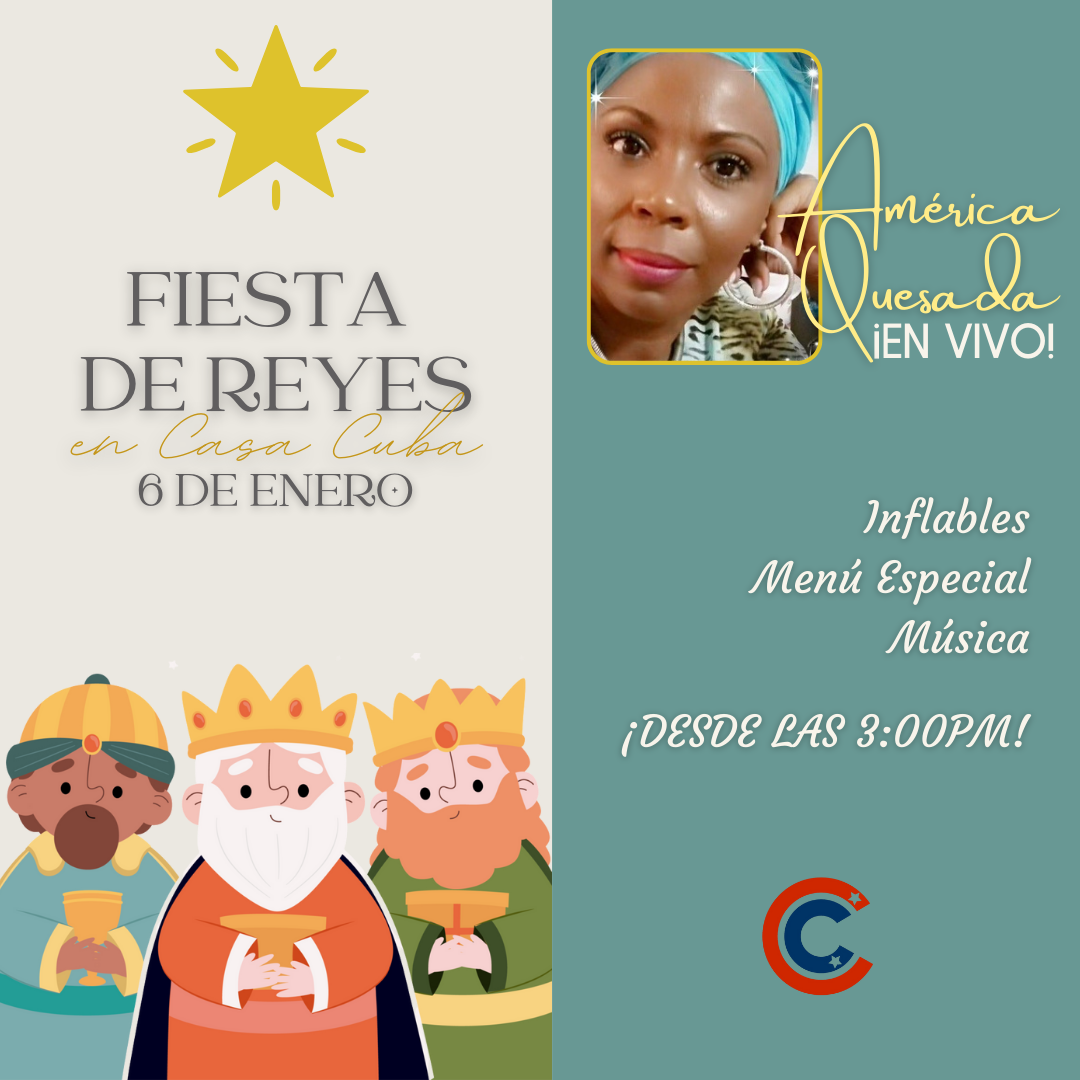
¡Fiesta de Reyes!

¡Fiesta de Reyes!

Celebremos en familia la tradición de los Santos Reyes
en una tarde "relax" frente al mar.

  • Música en vivo a cargo de la talentosa América Quesada
  • Sabroso y variado menú especial.  


¡Nos vemos en Casa Cuba!


Para más información puede llamar al 787 791-2743

SOCIOS@CASACUBAPR.COM


Facebook

Link

Website


Copyright © 2022 Circulo Cubano de PR, All rights reserved.
 

Our mailing address is:
PO Box 810409 Carolina, PR 00981-0409

Want to change how you receive these emails?
Unsubscribe from this list.


This email was sent to gerardomoreradelcampo@gmail.com 
why did I get this?    unsubscribe from this list    update subscription preferences 
Circulo Cubano PR · Calle Gardenia #10 · Urb. Biascochea · Carolina, PR 00979 · USA

CSI

12/29/2022
 
A publication of the Cuban Studies Institute
“Bits of Cuban History” is a new series of weekly publications highlighting historical events and information from Cuba’s colonial and national periods.
 
We hope you enjoy this new publication.
 
Following is the 50th in this new series.
 
 
BITS OF CUBAN HISTORY
 
 Rubén Fulgencio Batista y Zaldívar (1901-1973)

President of Cuba, 1940-44 and 1952-58 and Cuban strong man from the Sergeants’ revolt of 1933 to the Revolution of 1959. Born in Banes, Oriente province, January 16, the son of a sugar cutter, he spent his early years in poverty and attended a Quaker missionary school. After leaving school he worked as a tailor’s apprentice, cane-field laborer, grocery clerk, barber, and railroad worker before joining the army at age 20. The military afforded the opportunity for rapid upward mobility. An ambitious and energetic young man, “Beno” studied at night and graduated from the National School of Journalism. In 1928 he was advanced to sergeant and assigned as stenographer at Camp Columbia in Havana. 
 
Leading the Sergeants’ revolt of September 1933 brought him prominence and power. Before the year’s end Batista had become a colonel and the army’s chief of staff. He became a general in 1941.

On January 14, 1934, the unique alliance between students and the military collapsed and Batista forced the new president, Ramón Grau San Martín to resign, so ending the revolution begun with the overthrow of Gerardo Machado. Batista emerged as the arbiter of Cuba’s politics, particularly after he crushed the general strike of 1935. He ruled through puppet presidents until 1940, when he was himself elected. Desiring to win popular support, he sponsored an impressive body of social welfare legislation. Public administration, public health, education, and public works improved. He established rural hospitals, secured minimum wage legislation, increased salaries for public and private employees, and started a program of rural schools under army control. The army received higher pay, pensions, better food, and modern medical care, thus ensuring its loyalty. Batista also legalized the Cuban Communist Party. On December 9, 1941, following the Pearl Harbor attack, he brought Cuba into World War II on the allied side, and in 1943 he established diplomatic relations with the Soviet Union. In 1944 he allowed the election of his old rival, Grau San Martín. After an extensive tour of Central and South America he then settled at Daytona Beach, Florida, where he wrote the survey of his life and policies, Sombras de America (Mexico City:1946). In 1948, while still living in Florida, he was elected senator for Santa Clara province. He returned to Cuba the same year, organized his own party, and announced his candidacy for the June 1952 presidential election. Aware, perhaps, that he had little chance of winning, he and a group of army officers overthrew President Carlos Prío Socarrás on March 10, 1952, suspended Congress and the Constitution, canceled the elections, and dissolved all political parties.
 
Opposition soon developed, led primarily by university students who rioted and demonstrated frequently, culminating in the abortive Moncada attack of July 26, 1953. Batista seemed bent on staying in power. In the rigged election of November 1954, he was “reelected” for a four-year term from February 24, 1955. Although Cuba was prosperous, he neglected social, economic problems. Corruption and graft reached unprecedented proportions. Calls for new elections were ignored, but as political compromise seemed less and less likely, particularly after the collapse of the Diálogo Cívico, the adherents of violence grew in number. Student activism increased. Fidel Castro returned from Mexico to begin a guerrilla war in the countryside. Other groups organized an urban underground. The 1957 Presidential Palace attack by students and followers of deposed President Prío nearly succeeded in killing Batista. His government met terrorism with counterterrorism. Political prisoners were tortured and murdered.
 
By 1958 there had developed a national revulsion against the dictator and his methods. Finally, defections from the army precipitated the collapse of the regime. On December 31, 1958, Batista turned the presidency over to Carlos M. Piedra y Piedra and, at 2:10 in the morning of New Year’s Day, 1958, he flew into exile in the Dominican Republic, and later to Maderia, where he wrote several books, including his apologies for his divisive role in Cuban politics, Cuba Betrayed, and The Growth and Delcine of the Cuban Republic. Denied entry to the united States, he then moved to Madrid, where he died.
 
 
Read on Web
This is a publication of the Cuban Studies Institute. 

Our mailing address is:
1500 South Dixie Highway, Bank of America Bldg., 2nd Floor
Coral Gables, FL  33146
Tel: 786-803-8007
Fax: 786-803-8068
Email: cubanstudies@cubanstudiesinstitute.com

Want to change how you receive these emails?
You can update your preferences or unsubscribe from this list.
 

Partial Collapse In Havana, Cuba, Proving Socialism Is Deadly An Destructive

https://rumble.com/v22u9zq-partial-collapse-in-havana-cuba-proving-socialism-is-deadly-an-destructive.html

CSI

View this email in your browser


CUBANS IN AMERICA
 

CSI is pleased to announce a new interactive Webpage, “Cubans in America” available on the Internet at www.cubansinamerica.us
 
Cubans have had a significant social, economic, political, and cultural impact on the State of Florida and in other parts of the U.S.  For the past 60 years, more than 2 million Cubans settled in the U.S.  Education, politics, business, society has been affected by the Cuban migration.
 
The “Cubans in America” Webpage includes:
 

  1. History of Cuba Video.  A 26-minute summary of the history of Cuba narrated by Andy Garcia in English with Spanish Subtitles and a two-lesson course video by Carlos Alberto Montaner in Spanish.
  2. The Journey to Exile.  Short descriptions and videos of the various migrations toward U.S. including the Freedom Flights, Mariel, Balseros, Pedro Pan.
  3. Critical Moments. Short videos of the Bay of Pigs; the Missile Crisis; the downing of two Brothers to the Rescue planes on the Florida Straits, the Elian affair, and 2021 Uprising.
  4. Prominent Cuban-Americans/Organizations.  Short biographies with photos of several hundred Cuban-Americans in the arts, sports, business, academic, journalism, medicine/science, law/politics; religion as well as key organizations active in the U.S.
  5. Cuban-American Food (recipes)
  6. Cuban Music. Short descriptions of Cuban music genres plus video/interviews by Eloy Cepero with Cuba’s most prominent singers/composers, including Enrique Chia, La Coral Cubana, José Ruiz Elcoro, Añorada Cuba, Susy Leman, Hansel y Raul.
  7. Facts & Figures


Cubans in America serves as an information and research hub for community leaders, grade schools, universities, researchers, institutions, and the community in general interested in the significance of Cuban-Americans in the U.S. It covers historical and developing events resulting from the arrival of Cubans and their continued impact.

 
This database is a worldwide resource and point of information, sponsored by the State of Florida and the National Endowment for the Humanities, as an active, ever-expanding webpage of relevant material on the growth and development of generations of Cubans and Cuban-Americans in the U.S.


This is a publication of the Cuban Studies Institute. 

Our mailing address is:
1500 South Dixie Highway, Bank of America Bldg., 2nd Floor
Coral Gables, FL  33146
Tel: 786-803-8007
Fax: 786-803-8068
Email: cubanstudies@cubanstudiesinstitute.com

Want to change how you receive these emails?
You can update your preferences or unsubscribe from this list.

While Cubans Have No Food, Russian Consul Celebrates Opening Of Restaurant

https://rumble.com/v22nwqo-while-cubans-have-no-food-russian-consul-celebrates-opening-of-restaurant.html

CSI

A publication of the Cuban Studies Institute
 

December 27, 2022

 
Dear friend:

The Cuban Studies Institute has received a donation from Ralp Galliano of several copies of the important book, “The Fourh Floor” written by Earl E.T. Smith, former U.S Ambassador to Cuba.  The books is now out of print and discusses the Castro Communist Revolution and its impact on Cuba and on U.S. policy toward Cuba.

First published in 1962, The Fourth Floor describes in painful detail just how and why the communists were able to gain control of the strategically located island only ninety miles from the United States mainland.  Smith’s explanation of events remains timely today as it clearly demonstrates the disastrous effects of an ill-advised and ineffective foreign policy development structure.  As Smith’s title suggests, a great deal of responsibility for the Cuban fiasco must be borne by the bureaucrats who occupied the “fourth floor” of the State Department building in Washington, D.C.  As President Eisenhower’s “man in Havana” from July 1957 to January 1959, Ambassador Smith witnessed firsthand the events that resulted in the fall of Fulgencio Batista and the advent of Castro.

CSI is making this book available to our friends and followers for $35 per copy (free shipping).  The Fourth Floor is being sold at Amazon for more than twice this amount.

This is a valuable story of Castro rise to power and of the failures of American foreign policy in the 1950s.  Please order before this limited number of books are sold out.  Thank you.

Saludos


Jaime Suchlicki
Director


Order from: 

Cuban Studies Institute Name:_________________________________

Address:________________________________________________

City/State/Zip:____________________________________________

Phone:_________________________________________________

Email:__________________________________________________

Quantity: _______


Method of Payment

 [ ] Check enclosed (payable to Cuban Studies Institute

 [ ] Please place a one-time charge on the credit card listed for the amount of $______________

 [  ] MasterCard  [  ] Visa [  ] American Express [  ] Discover

 
Card Number:__________________________

CVV Number___________ Exp. _______

Name as it appears on card: ______________________________________________

Signature: ______________________________________

Date: ____________

 
By Phone: 786-803-8007
By Fax: 786-803-8068
By Mail:  Cuban Studies Institute, 1500 S. Dixie Highway, Suite 200, Bank of America Building, Coral Gables, FL 33146
 
THANK YOU!                                           
 

This is a publication of the Cuban Studies Institute. 

Our mailing address is:
1500 South Dixie Highway, Bank of America Bldg., 2nd Floor
Coral Gables, FL  33146
Tel: 786-803-8007
Fax: 786-803-8068
Email: cubanstudies@cubanstudiesinstitute.com

Want to change how you receive these emails?
You can update your preferences or unsubscribe from this list.