LET'S FIGHT BACK

LET'S FIGHT BACK
GOD BLESS AMERICA

Tuesday, September 30, 2014

Cuba's Military Generals at Center of Business Shakedown

Cuba's Military Generals at Center of Business Shakedown

Tuesday, September 30, 2014
Cuba's military generals control the island's economy.

The militarization of Cuba's economy began in the 1990's under then-Defense Minister, General Raul Castro.

That's Raul's real "reform".

The latest shakedown of foreign businessmen in Cuba is simply a further distribution of the "piñata" among Raul's family, friends and loyalists.

These are the military monopolists that some want the U.S. to illogically lift sanctions and do business with -- in the hope of some miraculous "trickle-down" effect (at best).

Yet, by definition and practice, these military monopolists are the very antithesis of "trickle-down".

If the U.S. were to lift sanctions, it'd simply be handing Raul and his military cohorts the biggest pie in the world to divvy up among themselves.

Something akin to the Russian mafia -- just 90 miles away.

From Canada's National Post:

Canadian businessman’s imprisonment in Cuba ‘very sinister,’ lawyer says

When lawyers for a Canadian businessman imprisoned in Cuba on charges of economic crimes against the state, taxation and bribery went to Havana to meet with tax officials over the allegations, they were taken to a state security office and told to meet with military generals instead, a company official said.

“They were pretty well intimidated and told we’re taking all of your assets and in addition you’re going have to send another $55-million down before Cy [Tokmakjian] would be released,” said Lee Hacker, a vice-president of the successful transportation company that Mr. Tokmakjian founded.

“There is something very sinister going on in Cuba,” he said.

SOCIALIST THIEFS TILL THE END

Castro Sought $55 Million Ransom for Release of Canadian Businessman

Sadly, some terrorist tactics never die.

From Reuters:


Cuba asked for $55 mln, assets to release Canadian CEO

Cuba offered to free jailed Canadian executive Cy Tok-
makjian in return for $55 million and company assets, his company said on Monday, but the deal fell through because the firm didn't have the money and the businessman wanted to clear his name.

Tokmakjian, 74, founder and chief executive of transportation firm Tokmakjian Group, was sentenced to 15 years in prison on Friday after being convicted of bribery and other economic charges in a case that lawyers and diplomats called a chilling development for potential foreign investors.

After Tokmakjian was detained in 2011, company lawyers met with Cuban officials about the case, said Lee Hacker, the Tokmakjian Group's vice-president for finance.

"They were... told 'We're taking all your assets and in addition you're going to have to send another $55 million down before Cy will be released,'" Hacker said.

It was the first time the company had revealed the Cuban demand, which could not be immediately confirmed with authorities in Havana. Tokmakjian's case has been shrouded in secrecy - he was held for two and a half years before being charged.

Hacker said he was told by the company's lawyers that there was no basis for the $55 million figure. "It was just a number that was thrown out," he told Reuters.

Cuba seized about $100 million worth of the firm's assets on the island and also sent two Tokmakjian aides to prison.


Quote of the Day: A Dangerous Condition for Doing Business in Cuba

Quote of the Day: A Dangerous Condition for Doing Business in Cuba

'Do as I say, but not as I do.' That seems to be the message being sent by these generals and lieutenant colonels turned professional business men. Not having a military rank is a dangerous condition for doing business on the island.
-- Ignacio Varona, Cuban independent journalist, on the case of imprisoned Canadian businessman Cy Tokmajkian, 14ymedio, 9/30/14

Toronto Star: Cuba Being Ungrateful for Canada's Trade and Tourism

Toronto Star: Cuba Being Ungrateful for Canada's Trade and Tourism

From The Toronto Star's Editorial Board:

Jailing Canadian investors can only hurt Cuba’s economy

Prime Minister Stephen Harper’s government should publicly decry Cuba’s jailing of a Canadian businessman, and lobby to have him released.

Cy Tokmakjian is a Canadian who has been doing business in Cuba for more than 20 years. All that time Fidel Castro and the government hailed him as a valued partner in developing the island’s feeble economy. His transportation, construction and mining equipment firm was one of the country’s biggest foreign investors, with $100 million in assets there.

Yet suddenly, in 2011, President Raúl Castro’s anti-corruption prosecutors set their sights on Tokmakjian and charged him and 16 others. After what his Concord-based company describes as a deeply flawed trial Tokmakjian, 74, has just been sentenced to 15 years behind bars, and the company’s assets have been seized. Two of his Canadian managers were jailed for 12 and eight years. And 14 Cubans including senior officials got up to 20 years.

Conservative MP Peter Kent calls the proceedings a “travesty of justice” and the sentence “outrageous.” The company says the trial was conducted largely in secret, and maintains that allegations of bribery, tax evasion, currency trafficking and other wrongdoing could easily have been refuted. But the defense was barred from calling expert witnesses. And defense lawyers got only limited access to state evidence. This appears to have fallen short of any credible standard.

Prime Minister Stephen Harper’s government should publicly decry this outcome and lobby to have Tokmakjian released and sent home as other Canadian and foreign businessmen have been in the past. He has been held for three years and is in frail health. His associates should be freed as well.

But the message should also go out that Canadians expect better of Cuba. Despite a 52-year American embargo we have consistently traded with Cuba and vacationed there. Last year Canada was Cuba’s fourth-largest trading partner after Venezuela, the entire European Union and China. We did nearly $1 billion in two-way trade. This is a poor recompense.

Finally the Castro regime should be put on notice that this can only cast a chill on its ambitious push to attract $2.5 billion annually in foreign investment to pump up its small, anemic economy. Havana urgently needs major investment in agriculture, tourism, infrastructure, light industry, energy, mining and other productive sectors. That may prove harder to attract now.

A country that Transparency International says is seen as seriously corrupt isn’t doing itself any favors by hauling in long-time foreign investors on dubious charges, holding less than credible trials, imposing harsh jail terms and seizing assets. If it is open season on Canadians, anyone is fair game. There are safer places to make a buck.

Arab Media Lauds Israel’s Treatment of Palestinian Workers

A Palestinian woman works at the Israeli SodaStream factory. (Photo by Nati Shohat/Flash90)
The Arab media usually takes an extremely negative stance towards Israel, but regarding Israel’s treatment of its Palestinian workers, there is only praise.   
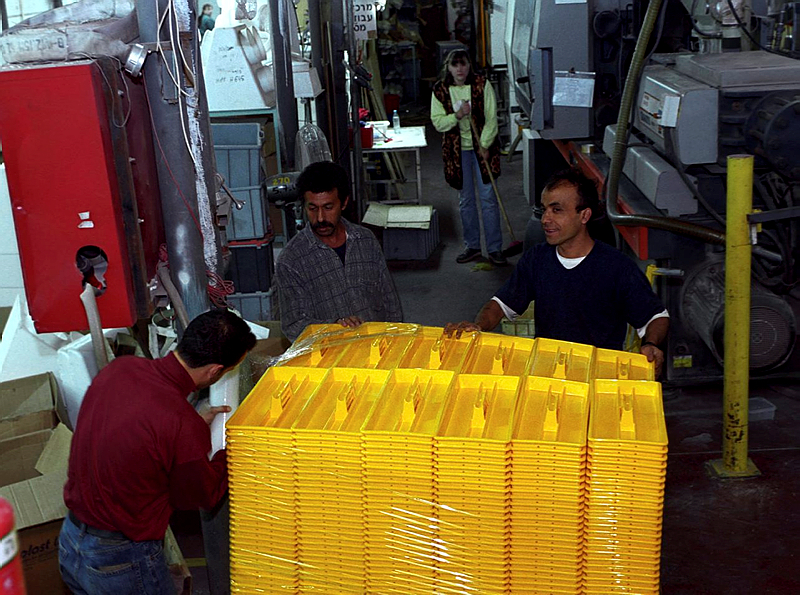
Palestinian employees working at an Israeli factory in Barkan, Samaria. (Photo: Flash90)
Palestinian employees working at an Israeli factory at the Barkan Industrial Park in Samaria. (Photo: Flash90)
The Palestinian Authority (PA)-controlled media is notorious for itspublishing of incitement and lies against Israel, but there is always an exception to every rule. An article recently published by the PA official daily Al-Hayat Al-Jadida lauds Israel and Israeli employers of Palestinians for their positive employment ethics towards their workers, Palestinian Media Watch (PMW) reports.
The article explains that Palestinian workers get their full rights when employed by Israelis directly; in fact, the only time that is not the case is when there is a Palestinian middleman.
“The only cases in which a Palestinian worker does not receive the salary his Israeli [employer] determined for him are those cases in which the middleman is Palestinian,” PMW quotes the paper as saying.

Higher Wages, Better Benefits

According to data presented by the Palestinian Bureau of Statistics (PBS), Palestinian employees in Israeli factories earn two-to-three times more than the average pay earned by the general Palestinian population, and they receive full social benefits as prescribed by Israeli law. The average daily wages for Palestinians employed by Israelis increased from 178.9 NIS in the third quarter of 2013 to 182.9 NIS in the fourth quarter of the year.
At the same time, the Al-Hayat Al-Jadida article condemned Palestinian employers for taking advantage of their workers, PMW points out. “Whenever Palestinian workers have the opportunity to work for Israeli employers, they are quick to quit their jobs with their Palestinian employers – for reasons having to do with salaries and other rights… The [Israeli] work conditions are very good, and include transportation, medical insurance and pensions. These things do not exist with Palestinian employers.”
The article compares the work conditions provided by Israeli and Palestinian employers.
“Muhammad Al-Hinnawi, a construction worker, says: ‘I receive a daily salary of 70 shekels, without pension, and I have no other choice.’ By contrast, Thaer Al-Louzi, who used to work for an Israeli concrete factory, notes: ‘I received a salary of 140 shekels a day. Now, after I was injured, I receive a salary through the insurance.’”

Job Security and Stability

This is not the first time Israel has been praised for its high standards and exemplary treatment of Palestinian employees.
The Al-Hura Arab language TV network ran a segment earlier this year on unemployment in the Palestinian Authority. Part of the presentation focused on Palestinians employed by Israeli-owned factories in Judea and Samaria that are constantly under the threat of boycott, divestment and sanctions (BDS), especially by countries from the European Union.
Yossi Dagan (R) meets with an EU Parliament member. (Photo: Shomron Local Council)
Yossi Dagan (R), deputy head of Samaria Regional Council, meets with an EU Parliament member. (Photo: Samaria Regional Council)
A Palestinian employee at the Barkan industrial park in Samaria told the Al-Hura reporter: “Living is expensive and the financial state is very difficult. There are places of employment that do not pay you in the end. Here I work and get paid every month with no problems.”
The reporter added that the financial state in the Palestinian Authority is dire and that these people, by working in Israeli factories, help alleviate unemployment in the PA.
“According to our data there is a 23% unemployment rate in the PA and 33% live under the poverty line as defined by the PA,” said Dr. Muhamad Aashatiya, PA Chair Mahmoud Abbas’s senior adviser. “It’s not enough to tell people not to work in Israeli factories. You need to provide an alternative,” he added.

Side by Side with Israelis

Deputy Head of the Samaria Regional Council Yossi Dagan, who participated in the TV feature, explained:
“There are 10 large industrial centers in Judea and Samaria, in which some 15,000 Palestinians work side by side with Israeli employees. At Barkan alone 3,000 Palestinians are employed together with 3,000 Israeli employees. They work together, earning the same wages, enjoying the same social benefits, vacation days and pension as prescribed by Israeli law. They go on trips together. Coexistence between the two peoples happens here, and all are awarded with a good and respectable livelihood.”
Author: Aryeh Savir
Staff Writer, United With Israel
(With files from the Palestinian Media Watch)

Israeli Scientists Develop Safe Chemotherapy

(Photo: "Operator at microscope". Licensed under Public domain via Wikimedia Commons)
Israeli scientists combat cancer with nanotechnology, avoiding the dreadful side-affects of chemotherapy.  
Prof. Avi Schroeder. (Photo: technion.ac.il)
Israeli medical scientists have made an impressive advance in the war on cancer by developing safe but very effective methods of administering targeted chemotherapy.
Scientists at the Technion University in Haifa are working on a system that administers chemotherapy without causing the repercussions that cancer patients usually incur. This is because only 10 percent or less of a standard drug dose goes to the tumor, with the remaining 90 percent distributed elsewhere in the body.
Chemical Engineering Professor Avi Schroeder, head of the Technion Laboratory for Targeted Drug Delivery and Personalized Medicine Technologies, is developing, together with his team, nano-sized “factories” that manufacture protein-based cancer drugs inside the body upon reaching the tumor site. This system, another example of Israel’s important medical innovations, is based on similar processes found in nature. At 150 nanometers or less—1/1,000 the diameter of a strand of hair, these factories are injected into the patient and circulate in the blood until finding the tumor.
Another method developed by Technion scientists is a system that releases drugs inside the tumor itself, eliminating the damage to nearby healthy cells.
These systems enable doctors to tailor specific treatments for each patient, depending on his or her needs, and to target the tumor itself, avoiding the dreaded and notorious effects of chemotherapy.
“We want physicians to have better tools for predicting which drugs would be best for each patient, and get them to the target site more efficiently,” says Schroeder.
Author: Aryeh Savir
Staff Writer, United with Israel

WATCH: Obama Describes America As A Muslim Country

Does the United States have one of the largest Muslim populations in the world?

Here is the President of the United States speaking about the number of Muslims who live in the USA.